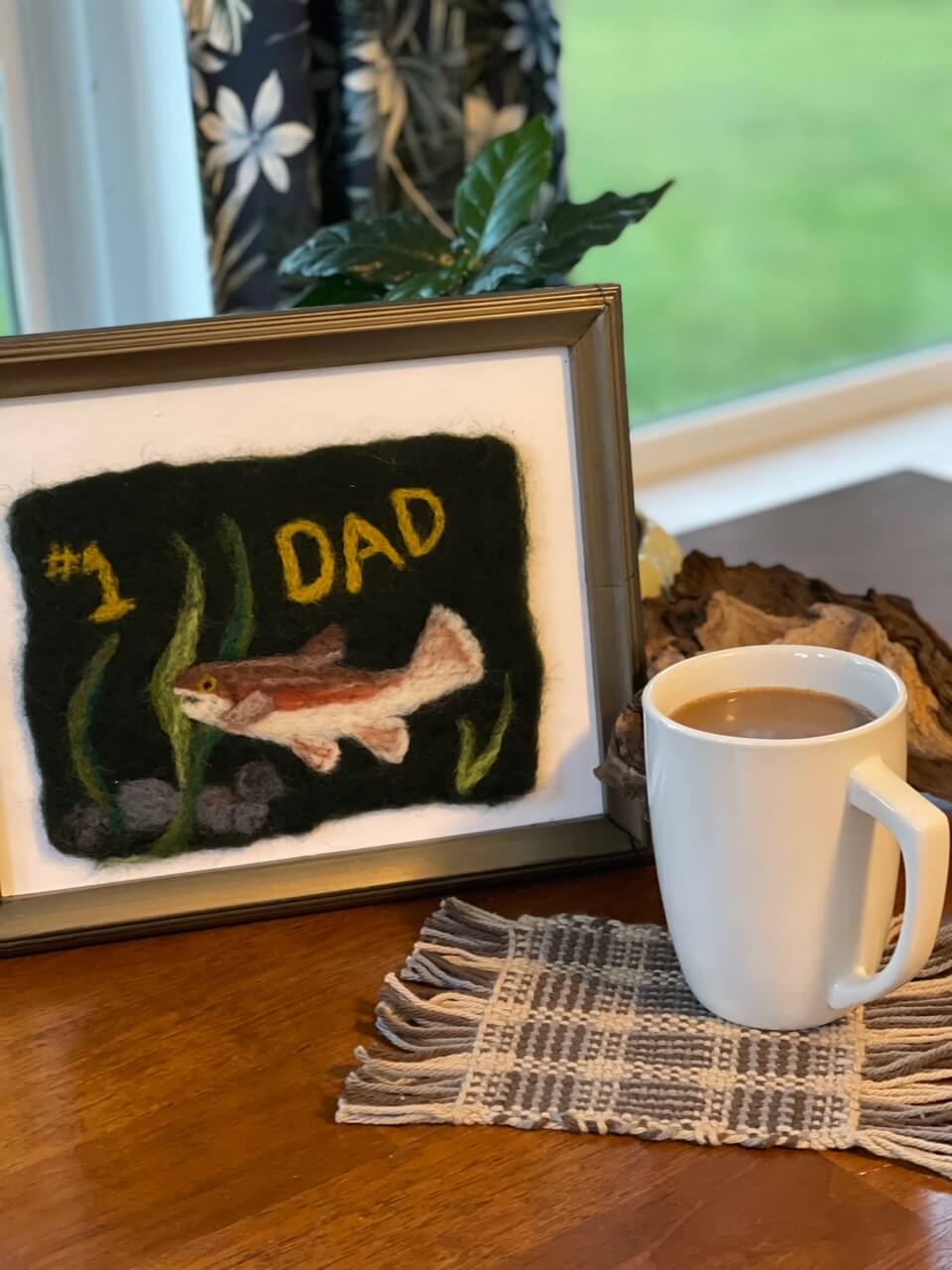
June Mug Rug
Got it! Here’s a clear breakdown of your June Log Cabin Mug Rug warp using the direct warping method on your 8-dent rigid heddle loom:
Warp sequence (loops per color):
- Start with 4 Tan (initial warp)
- 2 Brown
- 2 Grey
- 2 Brown
- 2 Grey
- 4 Tan
Repeat this entire 5-color sequence 4 times total.
This gives you a colorful, balanced Log Cabin pattern across the warp.
If you like, I can also show the weaving sequence for the weft so the Log Cabin structure comes out correctly and gives that “blocky cabin” look. Do you want me to do that next?
You should have a total of 52 ends.
This completes the warp. But now let’s learn something new!


Perfect! Let’s translate that into clear steps for warping your Log Cabin Mug Rug on a rigid heddle loom:
Understanding the draft:
- Color row (top) → shows the color of each warp thread.
- Numbers below (1 or 2) → indicate which “shaft” the thread goes through:
- 1 → hole
- 2 → slot
- Each loop in direct warping = 2 strands, so you’ll be working in multiples of 2 strands per block.
- Drafts are read right to left.
Warping sequence (following the horizontal row):
- Start on the right of the horizontal row.
- Warp 2 loops (4 strands) of Tan — corresponds to Block 1 (hole) and Block 2 (slot).
- Warp 1 loop (2 strands) of Grey.
- Warp 1 loop (2 strands) of Brown.
- Warp 1 loop (2 strands) of Grey.
- Warp 1 loop (2 strands) of Brown.
Repeat this sequence across the width of your rug as indicated in the pattern.
This sets up the alternating colors for your Log Cabin blocks, ready for weaving.
If you want, I can make a visual diagram showing which threads go in holes vs slots for this exact pattern — it makes threading the heddle super easy. Do you want me to do that?Then warp 2 loops (4 stands) of tan.
Repeat this section a total of 4 times as indicated above the row.
Refer back to this graph when you are ready to place them into the corresponding holes and slots.


Exactly! Here’s the key point for that four-square corner block:
- On a floor loom, the corner block shows which shafts are tied to which treadles. Raising a treadle lifts certain shafts, creating the shed for your weave.
- On a rigid heddle loom, we only have 2 shafts (holes = shaft 1, slots = shaft 2).
- The rigid heddle mimics the tie-up automatically:
- Raising the heddle lifts the threads in the holes (shaft 1).
- Lowering the heddle lifts the threads in the slots (shaft 2).
So even though there’s no actual tie-up, understanding this concept helps you see how the blocks of your Log Cabin pattern interact, especially if you ever use a double heddle setup or try a multi-shaft pattern.
Think of it as “mental tie-up” — it tells you which threads are active in each shed so your weave looks correct.

Exactly! You’ve summarized it perfectly. A few key takeaways:
- Up position = shaft #1 engaged → threads in the holes rise.
- Down position = shaft #2 engaged → threads in the slots rise.
- The rigid heddle automatically mimics the tie-up of a floor loom, so you don’t need to do anything extra.
- Black squares or omitted numbers in drafts are just other ways of showing the same thing — which threads are lifted at any point.
- Carrying the weft along the edges instead of cutting it prevents loops and keeps the selvage neat. Wrapping it with other wefts along the side minimizes bulk.
- Alternating weft colors (grey and brown) without cutting within each section helps maintain clean color blocks in the Log Cabin design.
Your loom is now fully warped, with 52 ends in the correct hole/slot sequence, and you’re ready to weave!

Exactly! That’s the fun part—once your warp is ready, the weft sequence brings the design to life. A few points to reinforce what you outlined:
- Always read the weft sequence top-to-bottom on the draft, just like you read a chart.
- Heddle up = holes raised (shaft #1); Heddle down = slots rise (shaft #2). This determines which warp threads the weft passes over and under.
- Start with a hem stitch and leave a tail at the beginning to secure the edge.
- Work in groups of passes, as indicated by the draft (e.g., 4 passes of tan, then switch to grey, etc.).
- Carry your weft along the edges, wrapping it with the engaged weft as you go. This keeps your selvage neat and prevents loops.
- Repeat sections exactly as shown, paying attention to color and number of passes. Small changes in weft color can dramatically change the look, so it’s a great opportunity to experiment.
- Finish with another hem stitch to lock in the final row.
Once you’re comfortable with this, you can tackle longer projects or more complex color sequences with confidence and share it on FaceBook Kromski Fun group.